A 60–120 Point, Schedule-Driven Summer SAT Plan for Students
A step by step guide to choosing the right prep format and creating a summer study schedule that works.

Rajiv Sharma
Educational Consultant @ Educo

A 60–120 Point, Schedule-Driven Summer SAT Plan for Students
For most students, summer is the absolute best window to raise their SAT scores. That's mainly because it strips away the schedule conflicts that sabotage prep during the school year. Yet, the right next step is not picking a program yet. It's taking a timed, official Bluebook diagnostic under real testing conditions, so every decision after that is based on data instead of a guess.
Choosing a Summer SAT Prep Format That Fits Your Schedule
Summer SAT prep comes in four basic shapes, and picking the wrong one wastes weeks a student cannot get back. Each format trades intensity for flexibility differently, so the right fit depends on how much time the student has, how self-directed they are, and how many points they need.
Bootcamps (typically 1 to 2 weeks, 20 to 30 hours total): Best for students who test well under pressure and need a final push before an August or September date. The compressed format works against a student starting from a low baseline, since there is no time to fix foundational gaps.
Multi-week intensives (4 to 8 weeks, 3 to 5 sessions weekly): The default choice for students targeting 80 to 150 points who need both content review and pacing work. A typical week might include two content sessions, one full-length practice test, and one review session built around the error log.
Weekly tutoring (ongoing, 1 to 2 sessions weekly): Fits students juggling jobs, camps, or travel, and works well when paired with independent practice between sessions. Progress is slower per week but compounds well over 8 to 10 weeks.
Hybrid or self-study (flexible, app and book based): Lowest cost, highest demand on self-discipline. Works for highly motivated students using tools like Khan Academy's official practice or a structured SAT prep book for summer study, but it is the format most likely to stall without outside accountability.
How Do You Build a Week-by-Week Summer SAT Study Schedule?
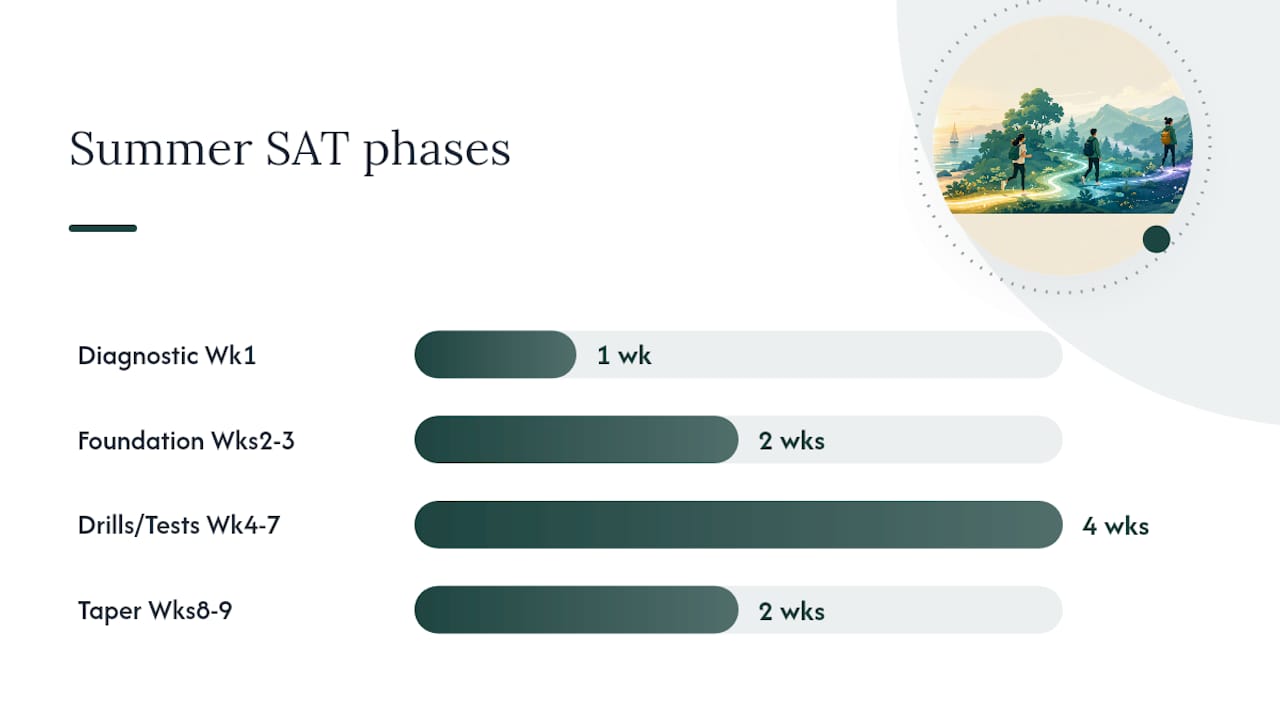
A summer SAT study schedule works best when it moves through four distinct phases instead of blending drilling and testing from day one. Rushing into timed full tests before fixing content gaps just reinforces the same mistakes at speed.
Week 1: Diagnostic and baseline. Take a full, timed Bluebook diagnostic under real conditions, then build an error log that tags every missed question by topic, skill, and mistake type (careless error, timing pressure, content gap). This log becomes the single most important document of the summer.
Weeks 2 to 3: Foundation and accuracy. Shift to untimed, accuracy-focused practice on the weakest topics identified in the error log before adding any time pressure back in. Test Prep Scout's summer prep guidance backs this sequencing: rebuild the skill first, then race the clock.
Weeks 4 to 7: Targeted drilling and weekly full tests. Alternate between focused drills on persistent weak spots and one full-length practice test every week or every other week, followed by a full review session the next day.
Weeks 8 to 9: Taper and refine. Cut volume, sharpen strategy on the remaining error categories, and take one final full-length test roughly a week before the actual exam.
For weekly hours, a sustainable pace runs 4 to 8 hours, while students chasing a larger jump in a shorter window often push to 10 to 18 hours, according to Test Prep Scout's pacing recommendations. Plan the whole sequence backward from the target date. Clear Choice Test Prep's planning framework recommends counting the actual usable sessions on the calendar and assigning one clear objective to each, rather than building an idealized plan that ignores vacations and camp schedules. Most students targeting the fall should aim for the August or September SAT administration dates, both listed on the College Board's official schedule.
Pro Tip: Schedule full-length practice tests for Saturday or Sunday morning, the same time of day as the real exam, and block off the following day entirely for review. The score gain comes from dissecting what went wrong, not from the test itself.
What Should a Strong Summer SAT Program Actually Include?
Program marketing pages tend to use the same vague language, "personalized," "proven," "expert instructors," so it helps to know exactly which features separate a real curriculum from a repackaged workbook. A program's syllabus should answer these questions before a family commits to it.
Curriculum structure: Does it cover content review (math concepts, grammar rules, reading strategy) alongside timed practice, or is it just one or the other?
Bluebook compatibility: Are practice tests delivered through the official Bluebook app so the adaptive section behavior matches the real Digital SAT?
Error-log review: Is there a structured process for reviewing missed questions, or does the program just hand back a score report?
Progress tracking: Does the program show score trends over multiple tests, not just a single before-and-after comparison?
Instructor background: Are instructors credentialed test-prep specialists, and what is the student-to-instructor ratio in group formats?
A program that cannot answer these clearly is likely offering generic content delivery rather than a measurable path to a score increase.
How Do You Pick the Right Summer SAT Prep Option?
Choosing between a bootcamp, a tutor, or an online SAT prep program comes down to five factors: schedule fit, measurable goals, instructor quality, testing cadence, and how price compares to the accountability the option provides.
Before signing up for anything, ask the program directly:
How many full-length Bluebook practice tests are included, and on what schedule?
What is the instructor-to-student ratio, and are sessions live, recorded, or self-paced?
How is progress reported, weekly score estimates, error-log summaries, or something else?
What happens if the student's score has not moved by the midpoint of the program?
A realistic summer target for most students is a 60 to 120 point improvement over 6 to 10 weeks of consistent, structured work, according to XMocks' summer roadmap analysis. Treat any program promising far more than that in a shorter window as a red flag worth questioning closely, and ask specifically how they define and track that gain.
Our Take on Making Summer Count
The programs that work best don't skip the diagnostic to get to the "exciting" part faster. They start there, build an error log, and let that log drive every drilling session that follows. Students expecting a 200 point jump from three weeks of a bootcamp are usually setting up a disappointing fall. A 60 to 120 point gain over 6 to 10 weeks is realistic; anything past that usually needs sustained work into the fall testing window, not just summer. Bootcamps suit students close to their ceiling who need final polish; tutoring suits students with real content gaps who need sustained, adjustable pacing.
Get a Data-Driven Summer SAT Plan With Educo
Educo is built around the exact roadmap outlined above: a diagnostic first, then a study plan built from what the error log actually shows, not a generic syllabus. Every session ties back to measurable progress, which is why families report gains that often exceed 100 points, and why Educo backs its work with a score-improvement guarantee, a rare commitment in the tutoring industry.
Educo's Ivy League educated tutors work especially well for students who need more than a scripted bootcamp: kids with specific content gaps, timing issues that show up only under real pressure, or a target score that requires sustained, adjustable coaching rather than a one-size curriculum. A first consultation typically starts with reviewing the student's diagnostic results and setting a concrete score target for the fall test date. If summer is the block you want to use well, start with Educo's SAT prep program and get a plan built around your student's actual numbers instead of a generic timeline.
FAQ
How Many Hours a Week Should Summer SAT Prep Take?
A sustainable pace runs 4 to 8 hours weekly for steady, low-burnout progress, while students aiming for a faster or larger score jump often commit to 10 to 18 hours weekly. The right number depends on the target score gain and how many weeks remain before the test date.
Is 1200-1300-1400 Out of 1600 a Good SAT Score?
A score slightly above 1100 is solidly above average and competitive for a wide range of four-year colleges. Whether it's "good enough" depends entirely on the target schools' typical admitted-student range, which families can check against Educo's guide to what counts as a good SAT score.
Is a 1500 SAT Score in the Top 1%? Is it enough to admit me to the Ivy League?
A score well above 1400 places a student in a very high percentile nationally, generally in the top few percent of test takers, though the exact cutoff shifts slightly year to year based on the testing population. It's a strong score for most selective college applications.
Can Using AI / ChatGPT Get Me A 1600 on the SAT?
General-purpose AI tools are not built or validated for standardized test scoring, and relying on one for practice can reinforce wrong strategies rather than catch them. A structured diagnostic through official Bluebook practice tests remains the more reliable way to measure real performance.
What Score Is a 70% on the SAT?
Scoring around the national average reflects solid performance but usually leaves meaningful room for improvement with a focused summer study plan.
TL;DR – The Key Takeaways
A diagnostic test under real conditions is crucial to identify a student's weaknesses before selecting a summer prep program.
Most students aiming for a 60 to 120 point increase should focus on a structured, weekly plan over 6 to 10 weeks, not quick fixes.
Effective summer programs should include content review, official Bluebook practice tests, error-log analysis, and progress tracking.
Higher-intensity formats like bootcamps suit students close to their goal who need final polishing, while tutoring benefits students with specific gaps.
Training for measurable progress and personalized plans, such as Educo’s approach, produces better results than generic or rushed programs.
Relevant Articles