7 Common App Prompts 2026–27: Match Your Story, Avoid the Top Mistake
???

Emily Dawson
Founding Partner @ Educo

7 Common App Prompts 2026–27: Match Your Story, Avoid the Top Mistake
The Common App essay prompts for 2026-27 are unchanged from the prior cycle: applicants still choose one of seven prompts, and the personal statement still runs 250 to 650 words. Aim for 550 to 650 words if you want room for real reflection. The practical move now isn't hunting for a new angle. It's matching your strongest true story to the prompt that lets it breathe.
TL;DR – The Key Takeaways
Matching your strongest true story to an appropriate prompt simplifies drafting and ensures your essay clearly reflects a specific trait or experience.
Each prompt assesses different qualities, such as self-awareness, humility, authenticity, or growth, and requires a different storytelling approach.
The Common App essay system enforces a strict 250 to 650 words range, with 550 to 650 words recommended for enough reflection and scene-setting.
Essays should focus on specific moments, show genuine change, and avoid generic or overly polished conclusions to demonstrate real personal growth.
Creative structures are welcome but must directly answer the prompt's core question, and revision best practices emphasize clarity, specificity, and cutting over adding.
What Are the 2026-27 Common App Essay Prompts?
Common App confirmed on February 27, 2026 that this year's seven prompts carry over word for word from the previous cycle, continuing a pattern of stability that dates back to 2021. That continuity works in your favor. It means every essay guide, every past example, and every piece of coaching advice built around these categories still applies.
Here is the full list, with a note on what each prompt is actually trying to surface:
Prompt 1, background or identity. Some students have a background, identity, interest, or talent so meaningful they believe their application would be incomplete without it. This prompt tests self-awareness about what makes you distinct, not a résumé recap.
Prompt 2, obstacle or setback. The recounting of a time you faced a challenge, setback, or failure. Readers want the process of recovery, not just the crisis.
Prompt 3, challenged belief. A time you questioned or challenged a belief or idea. This measures intellectual humility, meaning whether you can admit you were wrong.
Prompt 4, gratitude. Reflect on something someone did for you that made you happy or thankful in a surprising way, and how that gratitude affected or motivated you.
Prompt 5, growth or accomplishment. Discuss an accomplishment, event, or realization that sparked personal growth or a new understanding of yourself or others.
Prompt 6, intellectual curiosity. Describe a topic, idea, or concept you find so engaging it makes you lose track of time, and why it grips you.
Prompt 7, topic of your choice. Share an essay on any topic of your choice, written from scratch or reused from another application.
Prompt 7 was the most selected prompt in the prior cycle at roughly 28%, with facing adversity close behind at about 23%. Popularity isn't a recommendation. It just means a lot of students had stories that didn't fit neatly into categories 1 through 6.
How Do You Choose the Right Prompt for Your Story?
Most students overthink this step, then underthink the essay itself. Flip that. Spend real time matching your story to a prompt, and the drafting gets easier because you already know what the essay needs to prove.
Run your idea through four questions before you commit:
What is this story actually about? Not the event itself, but the trait, value, or shift it reveals. If your answer is "I overcame a hard year," that's a setback story (Prompt 2). If it's "I realized I'd misjudged someone," that's Prompt 3.
Where is the turning point? Every strong essay has a hinge moment where perspective changes. If you can't locate one, the story may need more development before it fits any prompt well.
Did you change, or did the situation just resolve? Colleges care about internal movement. A story where the external problem gets fixed but you stay exactly the same reader rarely lands.
Does it map cleanly to Prompts 1 through 6? If yes, use that prompt. If your story is a genuine hybrid, or it doesn't touch identity, adversity, belief, gratitude, growth, or curiosity, that's when Prompt 7 earns its place.
Prompt 7 is the right call when a story is legitimately unclassifiable. It's the wrong call when a student picks it to avoid the discipline the other six prompts demand. A vague "topic of your choice" essay with no clear focus reads worse than a tightly matched Prompt 2 essay about a mediocre setback.
Before you consider a draft finished, run it through a submission checklist: Does this essay tell admissions officers something the rest of your application doesn't already show? Is there a clear before-and-after, not just an event description? Does the ending look forward instead of just tying things up neatly?
Pro Tip: Start your draft inside a specific moment, mid-scene, rather than with backstory. End with a sentence that points toward who you're becoming, not a summary of who you were.
What Does Each Prompt Actually Test, and What Goes Wrong?
Each of the seven prompts is measuring something different, and the biggest essay mistakes happen when students answer the wrong question well instead of the right question at all.
Prompt 1 asks you to prove distinctiveness through a scene, not a list. A weak version states an identity ("I'm the daughter of immigrants") and then explains its general significance in the abstract. A strong version drops the reader into one specific moment, translating a lease agreement at age eleven, arguing with a customer service line for a parent, and lets the identity emerge through action. The mistake to avoid: writing what amounts to a diversity statement instead of a story.
Prompt 2 rewards process over drama. Readers have read hundreds of essays about injuries, breakups, and family illness. What separates the strong ones isn't the severity of the setback. It's the granularity of how the student actually worked through it, including the false starts. A weak essay ends at the moment of recovery. A strong one shows the specific habits or beliefs that changed and stayed changed.
Prompt 3 requires actual humility, not a victory lap. This is the prompt where students most often sabotage themselves. Common App consultants note that many belief-challenge essays quietly pivot into arguing the student was right all along, which defeats the entire purpose of the prompt. The strongest versions show genuine reconsideration, including discomfort with being wrong.
Prompt 4 lives or dies on specificity. Generic gratitude essays, thanking a parent for "always supporting me," are the single most common failure mode here. A strong essay anchors to one surprising act, maybe a teacher who returned an ungraded essay with a single question instead of a grade, and traces exactly how that act changed a behavior or choice afterward.
Prompt 5 needs a before-and-after, plus evidence the growth stuck. It's not enough to describe an accomplishment. Show what you understood before, what shifted, and what you've done differently since, so the growth reads as ongoing rather than a one-time epiphany.
Prompt 6 should feel relational, not encyclopedic. Students frequently misread this prompt as an invitation to summarize a topic (space travel, ancient Rome, machine learning) rather than to show their relationship to it. Admissions readers care what you do because of the curiosity: the forums you argue in, the side project you built, the book you tracked down. A topic summary with no personal action attached is the most common miss.
Prompt 7 works only as a genuine exception. Use it when your story truly resists categorization, not as a shortcut around the discipline the other prompts require.
Across the prior cycle, "topic of your choice" and "facing adversity" alone accounted for roughly half of all prompt selections, according to Common App's own release, a reminder that clustering around familiar categories is normal, but it raises the bar for making your version distinct.
What Are the Word Count Rules and Submission Checks?
The Common App system enforces a hard 250 to 650 word window on the personal statement. Submit outside that range and the platform simply won't let the essay through.
Target 550 to 650 words, not the minimum. That range gives you enough space for a scene, a turn, and real reflection without padding.
Watch the account timeline. Common App typically rolls over existing accounts and opens the new application cycle in early August, so returning students should confirm their essay responses carried over correctly rather than assuming a blank slate.
Save drafts early and often. The platform autosaves, but don't treat that as a substitute for keeping your own backup copy in a document.
Check school-specific supplements separately. Your personal statement is shared across every school on your list, but supplemental essays have their own word counts and deadlines that don't follow the same rules.
Proofread out loud in your final pass. Reading a draft aloud catches awkward rhythm and repeated words that silent reading misses almost every time.
How Should You Brainstorm Ideas for Each Prompt?
Good brainstorming starts with memory, not with the prompt text. Instead of staring at Prompt 6 and asking "what am I curious about," make a list of ten moments from the last three years when you lost track of time. The prompt will sort itself out once you have real material.
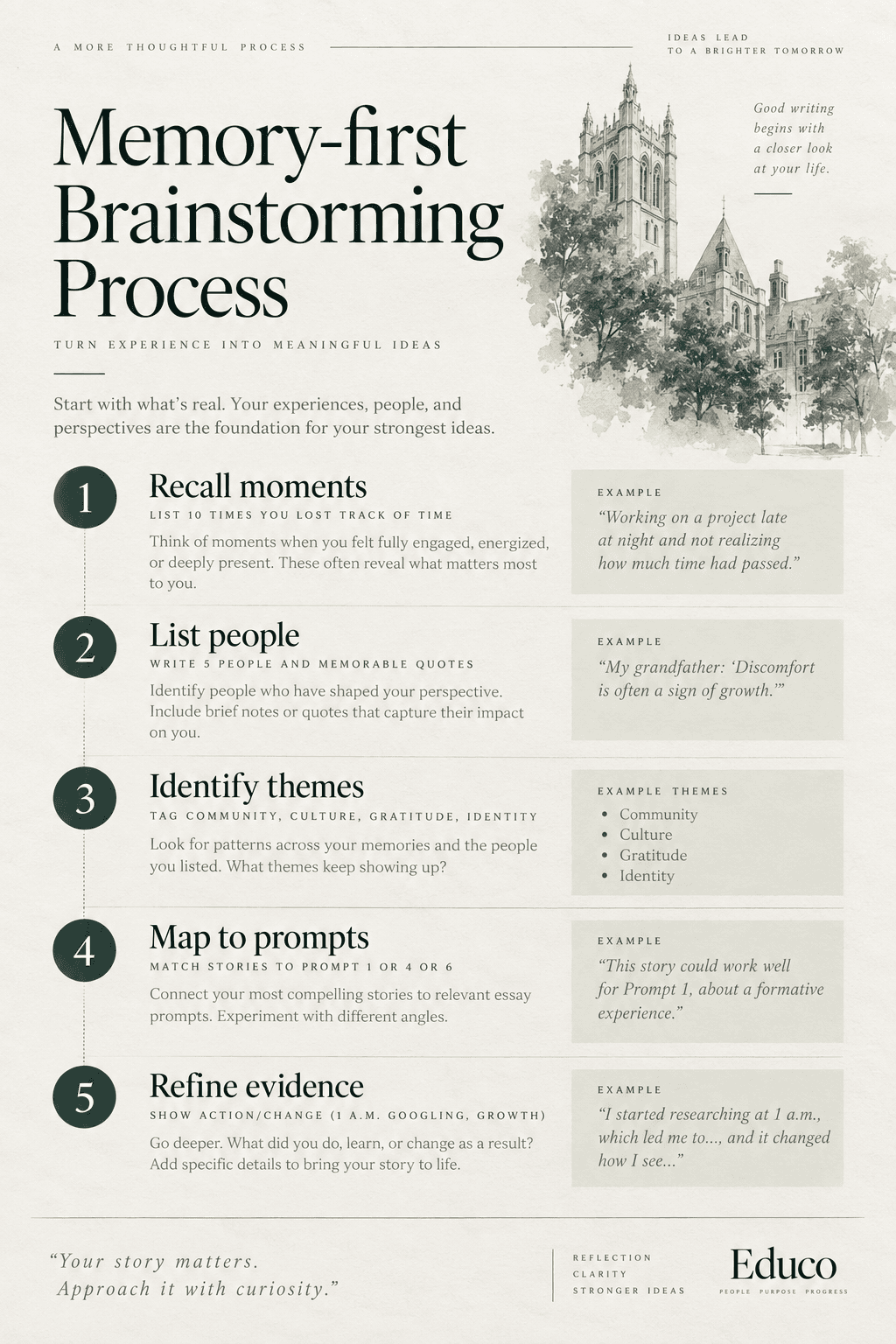
Common App's own guidance suggests starting from categories like community, culture, and the people who shaped you, rather than starting from the prompt language itself. Try this instead of freewriting cold: write down five people who've said something to you that you still remember word for word. That list alone will usually surface either a gratitude story (Prompt 4) or an identity story (Prompt 1).
For challenge and growth prompts, look for moments where your opinion of yourself changed, not just moments where circumstances were hard. A tough season isn't automatically essay material. The season where you noticed yourself becoming more patient, or less patient, or more willing to ask for help, usually is.
For the curiosity prompt, skip the topic and start with the action. What have you Googled at 1 a.m.? What forum have you argued in? What have you taught yourself outside of school with no grade attached? That evidence of self-directed action is what Prompt 6 actually wants.
If you're stuck generating raw material quickly, a structured drafting tool like AmmarAI's essay writer can help you get disorganized thoughts onto the page fast, though the reflection and voice still need to come from you in revision.
How Do You Show Real Personal Growth and Authenticity?
Authenticity isn't a writing style. It's a structural choice: telling the reader something true even when it's less flattering than the polished version.
The strongest essays in every prompt category share one trait: they include a moment of genuine uncertainty or discomfort, not just triumph. If your Prompt 5 essay about an accomplishment never mentions doubt, it probably isn't showing growth so much as narrating a highlight reel. Growth requires a visible gap between who you were and who you are, and that gap only reads as real when you're specific about what closed it.
Consultants who review these essays consistently point out that students try to guess what admissions committees want to hear, and that guessing is exactly what flattens an essay into something forgettable. The strongest personal statements reveal something about the student's character that the rest of the application, grades, scores, activity list, simply can't show. That's the actual job of this essay. Not persuasion. Revelation.
One practical test: if you removed your name from the essay and handed it to a friend, would they recognize you? If the voice sounds like it could belong to any strong applicant, it needs another pass. If it sounds like something only you could have written, because of a specific phrase you use, a specific memory only you have, you're close.
How Do You Balance Creativity With the Prompt's Requirements?
Creative structure is welcome. Ignoring what the prompt actually asks is not.
You can open mid-scene, use second-person address, structure the essay around a recurring object, or write in fragments if the fragments serve the story. Admissions readers see enough formulaic five-paragraph essays that structural risk, done well, stands out. But every creative choice has to still answer the prompt's actual question. A beautifully written Prompt 3 essay that never identifies a belief you actually held and changed isn't creative. It's off-topic.
The safest way to take creative risks is to draft the substance first in a plain, direct version, then revise for voice and structure second. Write the boring, accurate version of your story: what happened, what you learned, why it matters. Once that skeleton is solid, you can experiment with how you tell it, because you'll know exactly what has to survive the rewrite.
Watch for one common trap: using an unusual structure to avoid direct reflection. A fragmented, poetic essay can be a way of writing around the hard part instead of through it. If a reader can't tell what you actually learned after finishing your essay, the creative choices have hidden the substance rather than sharpened it.
What Are the Most Common Style and Voice Mistakes?
The essays that blur together in an admissions reader's memory almost always share the same handful of style problems, and every one of them is fixable in revision.
Thesaurus voice is the most common. Students reach for a bigger word because it sounds more impressive, and the sentence ends up sounding like nobody actually talks. If you wouldn't say a word out loud to a friend, don't put it in the essay.
Telling instead of showing shows up constantly in Prompt 1 and Prompt 5 essays, where a student states a trait ("I am resilient") rather than demonstrating it through a scene where resilience is visible in action.
The tidy ending wraps up growth with a bow, a single sentence like "and that's when I realized who I truly am," that resolves everything too neatly. Real growth is messier and often incomplete, and admissions readers can tell when an ending is manufactured rather than earned.
Passive, distant narration keeps the reader at arm's length from the moment. Compare "It was a difficult time for our family" against "My mother stopped answering the phone in the kitchen after 9 p.m." The second version does more work in half the words.
Overexplaining the obvious is the last habit worth cutting. If the scene itself shows a feeling, don't also state the feeling in the next sentence. Trust the reader.
Educo Perspective: How Admissions Coaches Refine Prompts and Drafts
The prompts themselves rarely cause weak essays. Vague prompt selection and thin revision do. When a draft comes across a desk, the first pass isn't line editing. It's four checks: is the story specific enough to belong to only this student, does the essay open inside a moment rather than backstory, is there a clear point of reflection rather than just an event, and does the structure carry a real arc from beginning to end.
What surprises a lot of families is how much of the improvement between a first and final draft comes from cutting, not adding. Students tend to over-explain their reflection instead of trusting a well-placed scene to carry it. Coaching at that stage means tracking specific, measurable shifts across drafts, whether the essay's reflection got sharper, whether the opening scene got more concrete, whether the ending stopped tying things up too neatly, and prioritizing revisions that move those markers rather than chasing stylistic polish for its own sake. That outcome-tracking discipline is the same one applied across test prep, and it works just as well on a personal statement as it does on a practice section score.
Get Expert Help Choosing and Revising Your Common App Essay
Picking the right prompt and getting an essay to 550 to 650 words of genuine reflection is harder alone than it looks on paper, especially when you're also juggling supplements and test prep on the same deadline. Learneduco pairs students with experienced coaches who run essays through a structured, measurable revision process, tracking specificity, narrative arc, and reflection depth from first draft to final.

If you already have a draft, a coach can tell you within one session whether it fits its prompt or needs to move to a different one. If you're starting from a blank page, we'll help you find the story first. Families who want to see how that process plays out can review real student outcomes before booking, or head straight to Learneduco to schedule an essay review session.
Frequently Asked Questions (FAQ)
How Many Words Should a Common App Essay Be in 2026?
The Common App personal essay must be between 250 and 650 words. While 650 words is the maximum, you should use the space you need to tell a complete story and reflect meaningfully rather than adding unnecessary content.
What Are the 7 Common App Essay Prompts for 2026–27?
The seven Common App prompts cover topics including background or identity, challenges and setbacks, meaningful experiences, gratitude, personal growth, intellectual curiosity, and a topic of your choice. The prompts remain unchanged for the 2026–27 application cycle.
Does the Common App Essay Prompt Change Every Year?
Not necessarily. Common App has kept the same seven essay prompts for the 2026–27 application cycle and announced that they would remain unchanged. Students should still check the current Common App requirements before beginning their college essays.
What Is the Difference Between a Common App Essay and a College Supplemental Essay?
The Common App essay is your primary personal statement and is submitted through the Common Application. Supplemental essays are additional writing questions required by individual colleges and may ask about your academic interests, community, experiences, or reasons for applying to that school. Requirements vary by college.
How Do I Choose a Common App Essay Topic?
Start with experiences that reveal something meaningful about how you think, what you value, or how you have changed. The strongest college essay topics do not need to be extraordinary. A specific, personal moment can be more effective than a broad story about an impressive accomplishment.
What Makes a Strong College Essay?
A strong college essay gives admissions readers a clear sense of your personality, perspective, and voice. Focus on specific experiences and details, then spend enough time explaining why the experience mattered and how it shaped the way you think. USC similarly describes the essay as an opportunity to understand the person behind the application.
How Should I Approach a “Why This College?” Essay?
Focus on the connection between your interests and the specific opportunities at the college. Rather than simply listing programs, professors, or campus features, explain why those opportunities matter to you and how they connect to your goals. USC's admissions guidance similarly emphasizes specificity and a clear connection between the student and the university.
When Should I Start Writing My College Essays?
Starting early gives you time to brainstorm, draft, revise, and get feedback without rushing the final version. A useful process is to begin with brainstorming and topic development, then move into a first draft before spending significant time polishing individual sentences.
Relevant Articles