Beat the 35 Minute Clock on ACT Reading: Two Per Passage Templates
Master ACT Reading pacing with two proven timing templates to help you finish all 36 questions in 35 minutes.

Ashley Lane
Educational Consultant @ Educo

Beat the 35 Minute Clock on ACT Reading: Two Per Passage Templates
Aim to allocate a few minutes per passage to reading, then several minutes to answering its questions, resulting in around one minute or less spent per question overall, which matches the official 35-minute, 36-question format exactly. Use that ratio on your very next practice set, track whether you finish with time to spare or time to spare, and adjust from there.
TL;DR – The Key Takeaways
Reading each passage in under 3 minutes during practice helps optimize accuracy without risking fatigue, especially for slower readers.
Tracking errors during timed drills reveals whether issues stem from comprehension, evidence location, or pacing, enabling targeted improvements.
Using a stopwatch without an alarm is the only permitted way to manage timing during the test, and consistent checkpoint checks maintain focus.
Fixing pace issues often requires faster evidence locating rather than increasing overall reading speed, which most students overlook.
Committing to one pacing template for at least two weeks ensures training brain reflexes for better time management on test day.
What Is the Official ACT Reading Timing?
The ACT Reading section gives you 35 minutes to answer all questions spread across four passages, according to ACT's own description of the reading test. Divide it out and you get roughly 8 minutes and 45 seconds per passage, or about 58 to 60 seconds per question if you ignore reading time entirely.
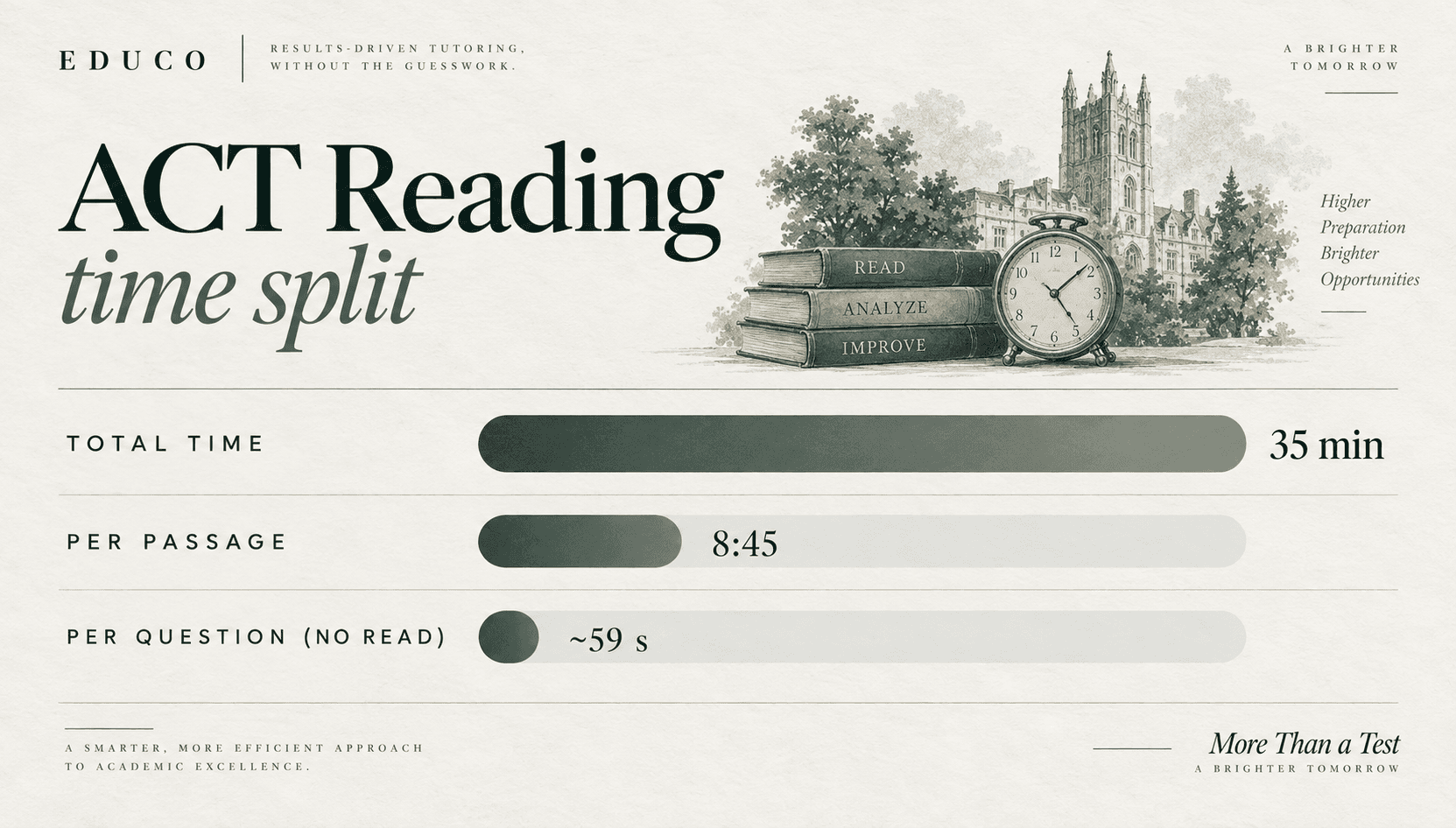
That number matters because it is tighter than most students expect. Some newer timing guides peg the enhanced ACT format at closer to 67 seconds per question once minor format adjustments are factored in, but the difference is small enough that the same pacing habits apply either way. Compare that to the digital SAT, where Reading and Writing modules allow about 71 seconds per question on average. Students who train on SAT pacing and then switch to ACT prep often run out of time, because they never retrained themselves to locate evidence in 15 to 30 seconds instead of lingering over a passage.
A few structural facts shape every pacing decision you'll make:
Multiple passages with several questions each, no partial credit for skipped items.
No penalty for guessing, so an unanswered question is always worse than a rushed guess.
Time is fixed at 35 minutes total; there's no separate clock per passage unless you set one yourself.
Quick fact: At 36 questions in 35 minutes, you have almost exactly one minute per question if you spent zero seconds reading. Since reading time is not optional, your real question-answering pace has to run faster than 60 seconds to make room for it.
Choosing Your Per-Passage Pacing Template
Two templates work for most students, and which one fits you depends on your baseline accuracy, not your ambition.
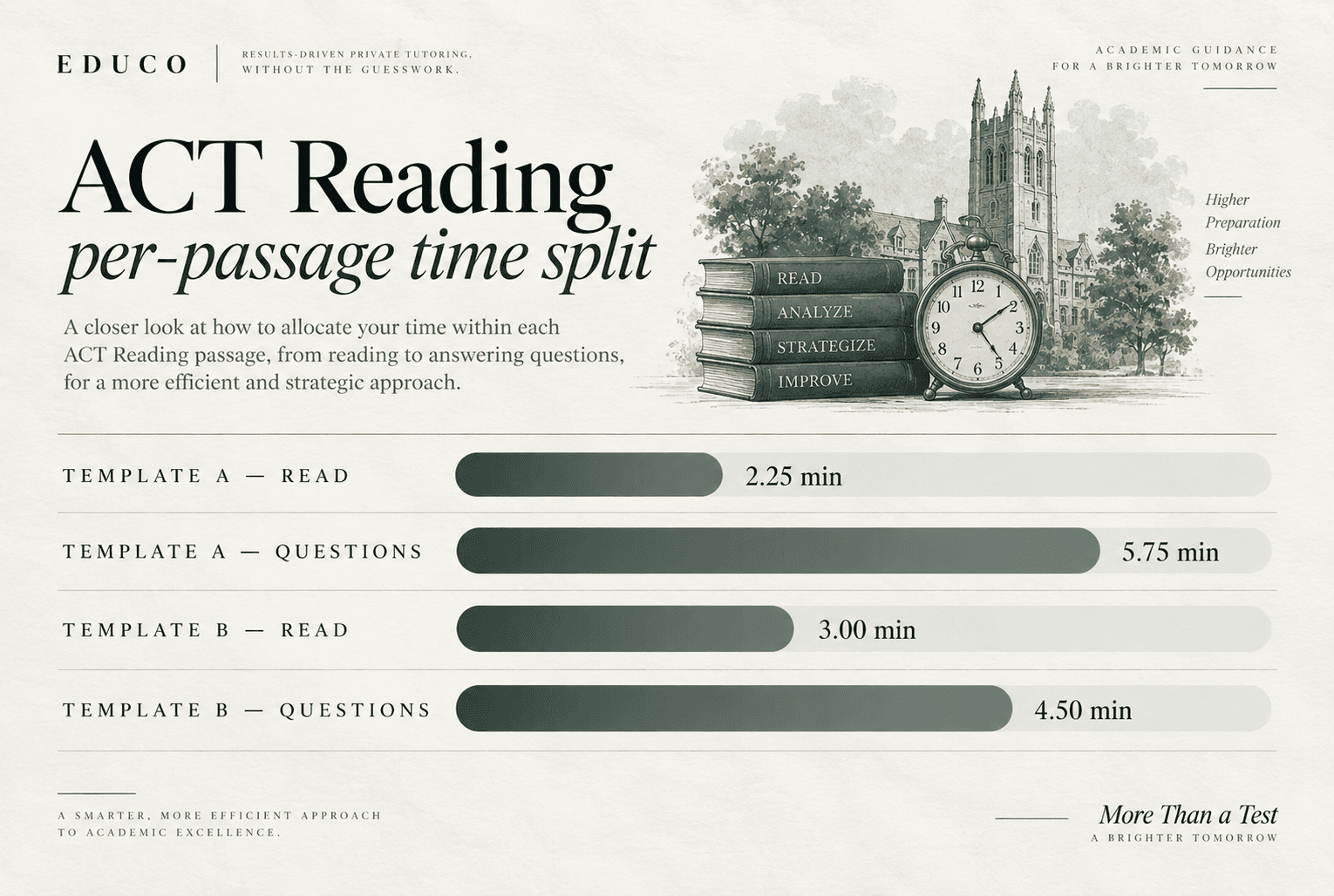
Template A: Aggressive. Read the passage in 2 to 2.5 minutes, then use 5.5 to 6 minutes for the nine questions. This works if you already read quickly and comprehend well on a first pass, but tend to run out of time before the fourth passage. It buys extra seconds for the harder inference questions that show up later in each question set.
Template B: Conservative. Read the passage in 3 minutes, then hold questions to about 4.5 minutes. This suits students whose accuracy drops when they skim too fast. You trade a slightly higher risk of running short on the last passage for meaningfully fewer careless errors on the first three.
Run a timed single passage under each template during separate practice sessions.
Compare accuracy, not just completion. A finished passage with six correct answers out of nine is worse than an unfinished one where seven of eight answered were right.
Pick whichever template produces higher accuracy at full completion, then stick with it for at least two weeks before switching again.
Pro Tip: Don't average your templates. Blending "sort of fast reading" with "sort of slow answering" produces the worst of both. Commit fully to one structure for a full practice test before judging it.
Here's how a conservative-template four-passage set might look on your desk clock, starting at zero:
That leaves a 15 second cushion before the section closes, which is exactly the margin you want. Zero cushion means one hard question derails the whole section.
How to Build Automatic Pacing Through Practice Drills
Pacing under real ACT reading timing pressure isn't a mindset, it's a trained reflex, and reflexes come from repetition, not pep talks.
Weeks 1 to 2: Single-passage drills. Time one passage at a time using your chosen template. Log every missed question and, more importantly, log why you missed it: misread the question stem, ran out of time, misidentified evidence. This error log becomes your most valuable diagnostic tool because tracking accuracy at a held pacing constant is exactly how tutors measure real improvement, rather than judging progress by speed alone.
This tests whether fatigue erodes your pacing discipline, which it often does around passage two.
Weeks 5 to 6: Full-section simulations. Run complete four-passage, 35-minute sections under true test conditions, then a full timed repeat a few days later reviewing only your error log from the first attempt.
Track three numbers every session:
Time remaining when you finish the section (or how far over you ran).
Accuracy percentage at your target pace.
Number of questions where you exceeded 60 seconds before moving on.
Advance to the next stage only when accuracy holds steady, not just when the clock cooperates.
Test-Day Timing Logistics and Permitted Tools
ACT test-day rules permit a watch for pacing, but with conditions: it must have no alarm function and must stay on your desk, not on your wrist, according to ACT's official test-day information. A smartwatch or anything with notification capability isn't allowed at all.
Quick fact: Proctors control the room clock, and its visibility varies by testing site. Some rooms have a large wall clock in clear view; others don't, which is precisely why bringing your own permitted watch matters.
Set your watch face up on the desk and check it at fixed checkpoints rather than continuously. Glancing every few seconds wastes focus; checking after each passage's reading portion and again after question five keeps you oriented without breaking concentration.
Practice with the exact watch you plan to bring, not a phone timer or app.
Build internal checkpoints, like "question 5 by minute 6," so your pacing sense doesn't collapse if you can't see a clock.
If the room clock isn't visible and you forgot a watch, rely on your trained internal pace from practice. This is exactly why the drills above matter.
Common ACT Reading Timing Mistakes and Fixes
Mistake: Getting stuck on one hard question. Fix: apply a strict 60-second rule. If you haven't found the answer in 60 seconds, flag it, guess your best option, and move on. Many test-prep guides treat this as one of the most reliable pacing rules precisely because one stubborn question can cost you two easy ones later.
Mistake: Re-reading the entire passage to find evidence. Fix: mark line references and paragraph topics during your first read so you can jump directly to the relevant section instead of scanning from the top.
Underline or mentally tag the main idea of each paragraph as you read.
When a question references "lines 20 to 25," go straight there instead of skimming from the start.
Practice this specifically. Timed repeats with immediate error review shrink evidence-locating time faster than untimed reading practice ever will.
Mistake: Fixed passage order regardless of content. Fix: if you consistently find one passage type (say, natural science) slower, do it last, not first, so early fatigue doesn't compound a weakness.
Pro Tip: In the final two minutes of the section, stop hunting for certainty. Answer every remaining question with your best guess before the proctor calls time. A guess beats a blank every time on the ACT.
A Tutor's View on Measuring Pacing Gains
Tutors who specialize in ACT Reading don't just clock students. They track time-to-first-answer on each passage and accuracy specifically at the target pace, because a student who finishes fast but misses six questions hasn't actually solved their timing problem.
The staged intervention that tends to work looks familiar: isolated timing drills first, then targeted skill work on whatever error category shows up most in the log (usually evidence-based questions or inference questions), then full timed sections to confirm the gains hold under real pressure. What surprises most students is how much of a "timing problem" turns out to be a comprehension problem wearing a stopwatch. If you're consistently running short on time, the fix is often faster evidence location, not faster reading speed. Those are different skills, and conflating them is where most self-guided pacing plans stall out.
How Educo Turns This Pacing Plan Into a Measured Score Gain
Reading a pacing article gets you the framework. Getting a tutor to watch you apply it, catch the exact question type where your seconds are leaking, and adjust your template in real time gets you the score. That's the gap Educo closes for ACT students in Manhattan.

Educo builds ACT prep around the same principle covered above: hold pacing constant, then measure accuracy against it. A typical short package starts with a baseline diagnostic to identify your natural reading speed and evidence-location gaps, moves into a drill cycle targeting whichever error pattern shows up most in your logs, then finishes with full timed simulations under real test-day conditions. Sessions run with Ivy-League-educated tutors who build a study plan from your actual error data, not a generic script, and the Educo approach is backed by a score-improvement guarantee, a first in the tutoring industry. If your practice scores have plateaued because your timing keeps breaking down on the last passage, visit Educo's test prep page to book a baseline assessment and get a pacing plan built around your own numbers.
References & Resources
Verify every rule before test day directly from ACT's own materials, not a secondhand summary.
Frequently Asked Questions (FAQ)
Is a 27 on ACT Reading a good score?
A 27 on ACT Reading is a solid score, but students targeting highly selective colleges may want to aim higher. Your ideal ACT Reading score depends on your overall ACT composite, target colleges, and the strength of the rest of your application.
Is a 36 on ACT Reading a good score?
Yes. A 36 on ACT Reading is a perfect section score and demonstrates exceptional performance. Because ACT Reading requires both strong comprehension and efficient time management, reaching 36 typically requires consistent accuracy under strict time limits.
Is a 33 ACT score good for Ivy League schools?
A 33 ACT is a strong score and can be competitive at highly selective colleges, including Ivy League schools. However, there is no single ACT score that guarantees admission. Admissions decisions also consider grades, course rigor, extracurricular activities, essays, recommendations, and other factors.
Is 32 out of 36 a good ACT score?
Yes. A 32 ACT composite is a strong score and can make a student competitive at many selective colleges. Students applying to the most selective universities may choose to target the mid-30s, depending on their academic profile and college list.
How can I improve my ACT Reading score and reading speed?
Focus on accuracy, evidence location, and pacing rather than simply trying to read faster. Timed ACT Reading passages, question-type drills, and a detailed error log can help you identify patterns and locate supporting evidence more efficiently.
How do I improve my ACT Reading score quickly?
Start by identifying which ACT Reading question types you miss most often. Then use targeted drills, timed passages, and an error log to address those weaknesses. Improving your pacing is most effective when you can maintain accuracy while working under the ACT Reading time limit.
What is a good ACT Reading score for college admissions?
A “good” ACT Reading score depends on the colleges you are targeting and your overall ACT composite. Students applying to selective universities generally benefit from strong section scores that are consistent with the academic profile of their target schools.
Does Educo offer ACT Reading tutoring?
Yes. Educo offers personalized ACT Reading tutoring focused on reading comprehension, question strategy, evidence location, pacing, and timed practice. ACT prep plans are built around each student's baseline score, target score, and specific areas for improvement.
Relevant Articles