Raise Your SAT Reading Score With 15 Minutes a Day: A 4–12 Week Plan
A practical, data driven 4 to 12 week plan for improving your SAT Reading and Writing score in just 15 minutes a day.

Derek Hayes
Educational Consultant @ Educo

Raise Your SAT Reading Score With 15 Minutes a Day: A 4–12 Week Plan
The SAT Reading and Writing section measures how precisely you can extract a claim, an inference, or a rhetorical purpose from a short passage and defend it with evidence from that exact text. The single highest-leverage move for improving your score is timed, short-passage drilling that forces you to point to a specific line before you pick an answer. This guide breaks down the test's structure, question types, and a week-by-week practice plan built around that habit.
TL;DR – The Key Takeaways
Short, timed passage drills that emphasize citing specific lines support faster recognition of question types and improve accuracy under test conditions.
Analyzing errors through detailed logs highlights whether mistakes stem from rushing or misunderstanding, guiding targeted practice.
Recognizing question groupings and difficulty progression helps manage time effectively and avoid spending too long on easier questions.
Official practice tests and Khan Academy resources are the most reliable for realistic preparation, especially when addressing specific skill weaknesses.
Consistent, focused practice on micro-skills and strategic question approach typically yields stronger score gains than merely increasing reading volume.
What's on the SAT Reading Comprehension Section?
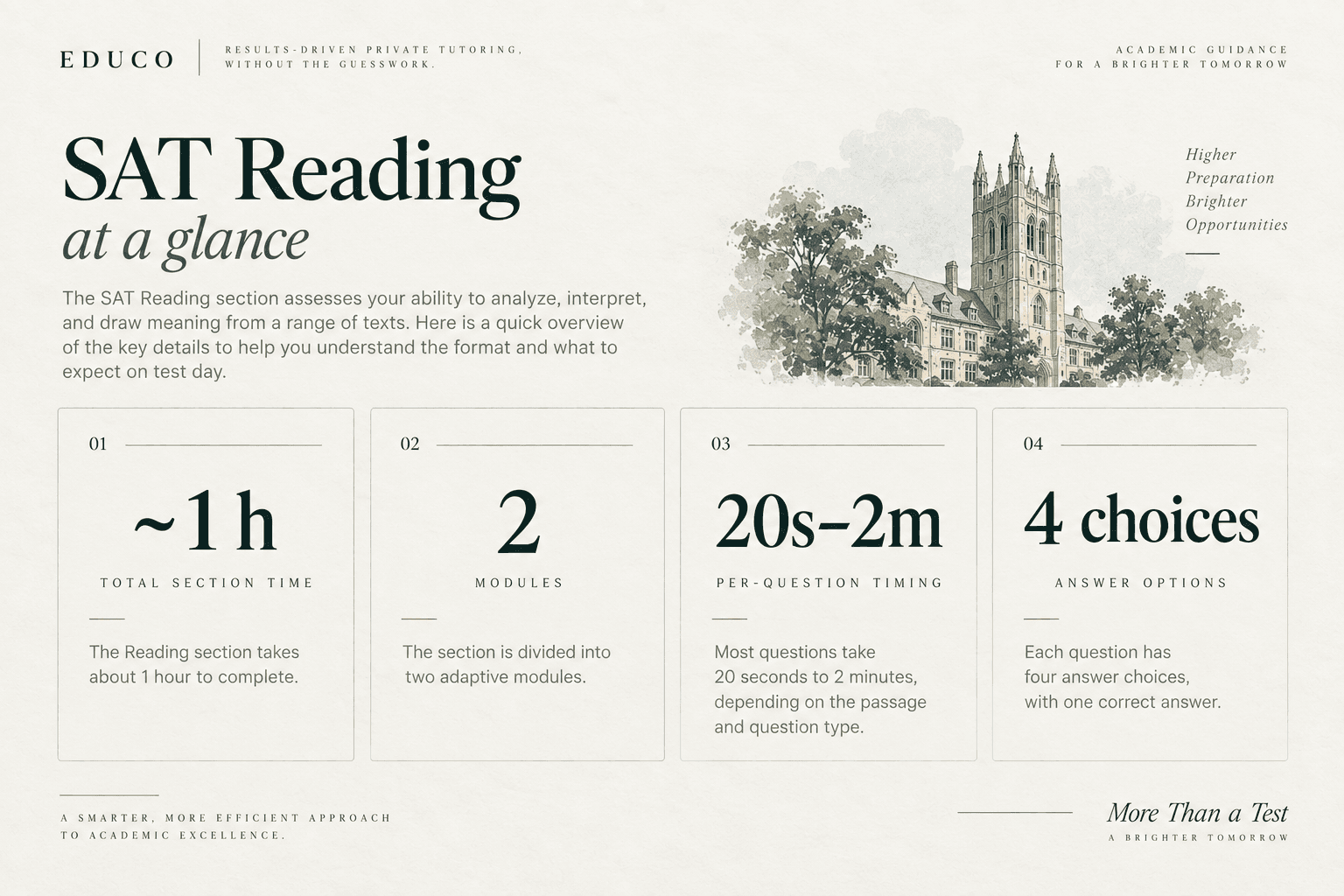
The digital SAT Reading and Writing section runs about an hour and contains numerous questions split across two modules, according to the official test spec overview. The pacing varies: some questions take as little as twenty seconds, others up to two minutes, and part of scoring well is knowing which is which.
Every question comes attached to its own short passage, typically a few sentences to a couple of paragraphs in length, and you answer based only on what that passage states or implies. There is no essay, no long reading passage stretching across a full page, and no need to hold five paragraphs of context in your head at once. This is a fundamentally different skill from the paper SAT's longer passages, and if you have only practiced with an old paper test or a printed prep book, your pacing instincts may be calibrated wrong. Educo has written about how the digital SAT differs from its paper predecessor in ways that catch even strong readers off guard.
Passages cover four broad subject areas: literature, history and social studies, humanities, and science. You will not need outside knowledge of any of them. A science passage might describe an experiment on coral bleaching, but the question never asks you to know marine biology. It asks whether you can read the sentence describing the experiment's result and match it to an answer choice.
Every question is multiple choice with four answer choices and a single best answer, confirmed by the official practice test format. There is no partial credit for a "sort of right" answer, and the test is designed so that three of the four choices are wrong for a specific, identifiable reason. Learning to spot that reason quickly is more valuable than reading faster.
Here's a structural detail that changes how you should pace yourself: questions are grouped by the skill they test and arranged from easier to harder within each group, based on the College Board's own description of the section. That means the third "central idea" question in a row is probably tougher than the first one you saw. If you're burning too much time on an early question in a cluster, that's a signal to flag it and move on rather than dig in, because harder versions of the same skill are still coming.
The adaptive design of the digital test also means your performance on the first module influences the difficulty of the second. Students sometimes treat this as a reason to panic if the first module feels hard. It shouldn't be. A harder second module usually means you're being routed toward a stronger score band, not punished.
SAT Reading Strategies That Actually Move Your Score
Most advice about reading comprehension is vague: "read carefully," "manage your time," "eliminate wrong answers." None of that tells you what to do differently tomorrow. Here's what actually changes results, ranked by how much impact it tends to have relative to how easy it is to adopt.
Read for structure, not just content. Before you look at the answer choices, mentally summarize the passage in one sentence: what is it claiming, and what is it doing to support that claim? This is sometimes called passage mapping, and it takes maybe 10 extra seconds. Those 10 seconds pay for themselves the moment you hit an inference or main-idea question, because you already have the answer roughly formed before you read the choices.
Apply the answer-from-text rule without exception. Every correct answer on this test is supported by specific words in the passage, not by what sounds reasonable or what you happen to know about the topic. If you can't point to the line that proves an answer choice, it's not the answer, no matter how plausible it sounds. This single rule eliminates more wrong answers than any vocabulary strategy.
Use an evidence-first process on support questions. When a question asks which choice best supports a claim, don't evaluate the four choices in isolation. Go back to the passage, find the one or two sentences that actually make the claim, and then match an answer choice to those specific sentences. Working backward from four options usually takes longer and invites you to talk yourself into a wrong choice.
Triage before you commit time. Because questions are grouped by skill and ordered from easier to harder, a stalled 45 seconds on question one in a cluster is a bad sign for questions two and three in that same cluster. Flag it, move on, and come back if time allows. Losing 90 seconds on one hard question to save 20 seconds on three easy ones later is a trade every strong scorer makes without thinking twice.
Handle vocabulary-in-context by substitution, not definition. Cover the underlined word and predict your own word that fits the sentence. Then find the answer choice closest to your prediction. This avoids the trap of choosing a word that's a correct dictionary synonym but wrong for that sentence's tone or context.
Practice in short, timed bursts rather than long study sessions. A 12-minute drill of five passages done daily builds more transferable skill than a single three-hour Sunday session, largely because the short passage format itself rewards sentence-level focus over sustained reading endurance. Mixed-topic rounds (switching between literature, science, and history passages within the same drill) also mirror the actual test better than practicing one subject area at a time.
Pro Tip: The most common trap on inference questions is an answer choice that's true in the real world but never actually implied by the passage. Test writers know students bring outside knowledge to the table, and they build wrong answers that exploit it. Before selecting an inference answer, ask yourself: "Does the passage actually point me here, or do I just happen to know this is true?" If it's the second one, it's a trap.
These techniques compound. Passage mapping makes the answer-from-text rule easier to apply because you already know where the claim lives. Triage becomes possible only once you can recognize question types fast enough to know which ones are worth your time. None of this replaces reading practice, but it turns unstructured reading into a repeatable process you can improve week over week.
How to Build a Practice Plan to Improve Your SAT Reading Score
Improving SAT reading comprehension isn't about reading more books. It's about running the right drills often enough that the answer-from-text process becomes automatic under time pressure. Here's a plan structured around that goal, scalable from four weeks to twelve depending on how much runway you have before test day.
Start with a baseline diagnostic. Take one full, timed Reading and Writing module under real conditions before you do anything else. Note your raw score, your time per question, and which of the six question types above gave you the most trouble. This baseline is what every later checkpoint gets compared against, so don't skip it and don't take it untimed.
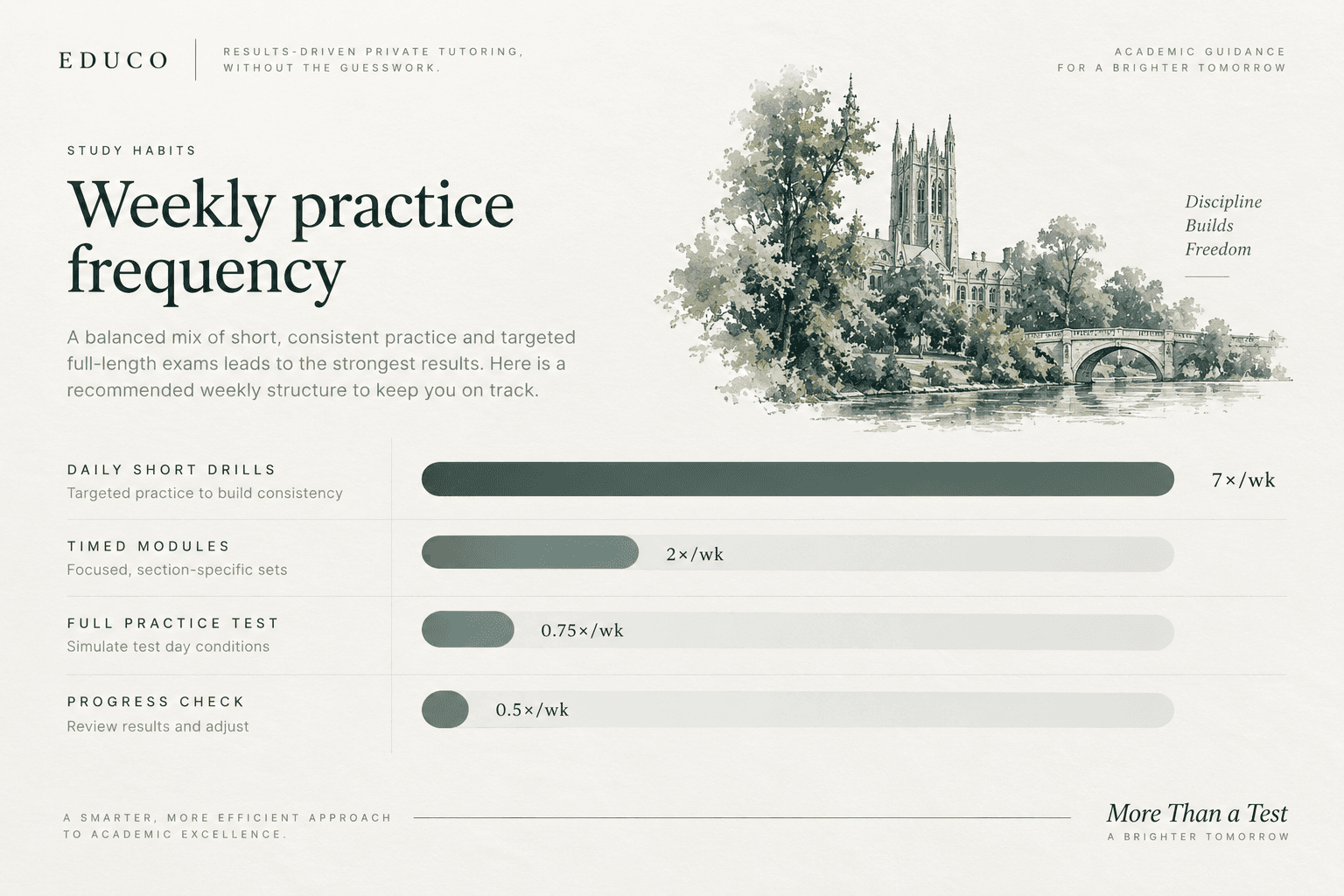
Structure each week around three components:
Daily short drills (15 to 20 minutes). Five to eight passages focused on a single question type. If your baseline showed weakness on inference questions, spend Monday and Tuesday drilling nothing but inference. This isolates the skill instead of diluting it across a mixed set where you can coast on your stronger question types.
Two timed modules per week. Full-length, mixed-topic modules under real time constraints. These test whether the skills from your daily drills are transferring under pressure, which is a different skill from doing them in isolation.
One full practice test every one to two weeks. Use an official practice test to simulate the complete testing experience, including the adaptive module structure. This is where pacing habits either hold up or fall apart.
Vary your drill construction as you progress:
Early weeks: single-question-type rounds to build recognition speed for each of the six question types.
Middle weeks: mixed-topic timed rounds that combine question types the way the real test does.
Ongoing throughout: evidence-only drills, where every question in the round is a support or inference question requiring you to cite the exact sentence that justifies your answer. A focused round of five passages built entirely around evidence-support questions is one of the more reliable ways to raise accuracy on that specific question type, because it forces the annotation habit under a deadline rather than letting you skim and guess.
Check your progress every two weeks, not daily. Score volatility from one practice set to the next is normal and doesn't mean much on its own. What matters is the two-week trend in two numbers: average time per question and accuracy rate by question type. If your inference accuracy hasn't moved after two full cycles of inference-focused drills, that's a signal to change the drill, not to do more of the same one.
Realistic milestones look something like this: by week two, you should see your time-per-question on easier clusters drop by a few seconds as recognition speed improves. By week four to six, accuracy on your weakest question type should start closing the gap with your strongest. By week eight or beyond, full practice tests should show less variance between attempts, which is often a better sign of readiness than any single high score.
Fit this around school realistically. Fifteen minutes a day is sustainable during a busy semester in a way that three-hour weekend sessions are not, and consistency beats intensity for skill-building of this kind. If you're trying to figure out how many total weeks you need before your test date, a realistic study-duration guide based on your starting score and goal score is worth reading before you commit to a schedule.
How Do You Analyze SAT Reading Mistakes Effectively?
Most students review a missed question by rereading the explanation, nodding, and moving on. That habit doesn't fix the underlying problem, because it doesn't tell you why you missed it in a way you can act on next time. An error log does.
For every missed question, record four things:
Question type (main idea, inference, vocabulary-in-context, and so on).
Passage subject area (literature, science, history, humanities), since some students consistently struggle with one subject's phrasing style more than others.
Time taken, so you can distinguish a rushed guess from a careful wrong answer.
Root cause of the error, chosen from a short set of categories: misread the question stem, picked an answer not supported by the text, ran out of time, or didn't know a vocabulary word.
That last category is the one that actually changes your practice. A "not supported by the text" error means you need more reps on the answer-from-text rule. A "ran out of time" error means your triage decisions need work, not your comprehension. Lumping both under "got it wrong" hides two completely different fixes behind one vague label.
Once you've logged 15 to 20 errors, patterns usually surface fast. If half your misses are inference questions where you picked something true in real life but not stated in the passage, that's your next week's drill focus, not a random mixed set.
Pro Tip: A time-based error and a knowledge-based error look identical on an answer sheet but need opposite fixes. If you got a question wrong because you rushed, slowing down on similar questions in your next drill is the right move. If you got it wrong because you genuinely didn't understand what the passage was doing, slowing down won't help. You'll just spend more time being confused. Diagnose which one happened before you decide how to practice it.
Retest a drill type once you've logged at least five new errors in that category and addressed the root cause. If your accuracy on that type improves for two consecutive drills, move on to your next weakest area rather than over-practicing a skill you've already fixed.
What Are the Best SAT Reading Practice Resources?
Not all practice materials are built to the same standard, and mixing low-quality third-party questions into your prep can teach you patterns that don't hold up on the real test. Here's how to prioritize what you use.
College Board's official practice tests should be your primary source for full-length, timed simulation. The official practice test PDFs mirror the actual item formats, answer choice structure, and difficulty progression you'll see on test day, which matters more than volume. Ten official questions teach you more about real test patterns than fifty questions from an unofficial source.
Khan Academy's official SAT practice, built in partnership with the College Board, is the best resource for skill-specific drilling and personalized practice paths. It's particularly useful during the early weeks of your plan when you're isolating individual question types, since it can route you toward more of whatever you're weakest on.
Curated short-passage banks work well for daily timed drills, but check that they match the digital test's actual passage length and question phrasing before you rely on them heavily. A passage bank built for the old paper SAT's longer passages will train the wrong pacing instincts.
Additional review resources, including supplementary practice test materials, can help you build a broader question bank once you've exhausted the official releases and Khan Academy's core sets.
If your vocabulary-in-context accuracy is lagging, targeted study matters more than generic word lists. Educo's breakdown of official vocabulary resources worth using explains which study methods actually transfer to test-day performance.
If your timeline is tight or your score plateau isn't moving despite consistent self-study, that's usually the point where working with a tutor who can run error-log analysis alongside you starts to outpace what you can diagnose alone. Free resources are excellent for structured, patient improvement. Paid tutoring closes the gap faster when the calendar doesn't allow for patience.
An Editorial Take on Structured Practice
The mistake I see most often isn't a lack of effort. It's students rereading entire passages three times looking for an answer instead of learning to locate the one sentence that actually matters. That single habit change, more than any vocabulary list or pacing trick, is what tends to move scores the fastest once students commit to it.
Educo builds its tutoring around that same principle: personalized, data-driven study plans shaped by detailed performance analysis rather than generic worksheets, delivered by Ivy-League-educated tutors who can spot a recurring error pattern in real time instead of waiting for a practice test to reveal it.
Get Personalized Help With Educo's SAT Reading Prep
Self-study works when you have the discipline to build an error log and stick to a drill schedule for weeks at a time. Not every student has the bandwidth for that alongside a full course load, and that's exactly where Educo's tutoring closes the gap faster than solo prep ever could.
Students are paired with tutors who build a tailored study plan from a real diagnostic, not a generic curriculum, and track progress through error analysis like that described in this guide, done by someone experienced with common patterns. Families working with Educo have seen score gains over 100 points, and a 92% retention rate suggests families stick around because the results hold up.
If you're prepping on your own and progress has stalled, or you simply want a faster, guided path, tutoring tends to make the biggest difference when a plateau has lasted more than two or three practice cycles without movement. Start with Educo's SAT prep program in NYC to get a diagnostic assessment and a study plan built around your specific weak points, backed by Educo's score guarantee.
Where to Verify These SAT Reading Facts
The claims about format, timing, and question types throughout this guide come directly from primary sources, not secondhand test-prep guides.
The digital SAT test spec overview is the authoritative source for section timing, question counts, and passage length. Check it directly if a third-party guide gives you a number that seems off.
The College Board's Reading and Writing section page breaks down the four content domains and explains how questions are grouped and ordered by difficulty.
Official practice test PDFs show you exactly what real questions look like, complete with answer keys, and should be your first stop before any third-party question bank.
SAT Reading and Writing FAQ
Does the SAT have a Reading section?
The current digital SAT does not have a standalone Reading section. Instead, reading comprehension is tested within the Reading and Writing section, which contains 54 questions across two 32 minute adaptive modules. Questions assess skills including comprehension, analysis, inference, vocabulary in context, evidence, and understanding an author’s purpose and structure.
What does the SAT Reading and Writing section test?
The SAT Reading and Writing section covers four content domains: Information and Ideas, Craft and Structure, Expression of Ideas, and Standard English Conventions. Together, these domains test reading comprehension, inference, evidence, vocabulary, rhetorical analysis, transitions, revision, grammar, punctuation, and sentence structure.
How many Reading and Writing questions are on the SAT?
There are 54 questions in the SAT Reading and Writing section. The questions are divided equally between two adaptive modules, with 27 questions in each module. Each module includes 25 operational questions and 2 pretest questions.
How much time do you get for SAT Reading and Writing?
Students have 64 minutes total, with 32 minutes for each of the two modules. That works out to approximately 1 minute and 11 seconds per question on average. Because question difficulty and reading demands vary, students may spend substantially more or less time on individual questions.
What types of reading questions are on the SAT?
SAT Reading and Writing questions can ask you to identify a central idea, make an inference, select supporting evidence, determine the meaning of a word in context, analyze an author's purpose, understand text structure, or compare ideas across related texts. Some questions also require students to interpret information presented in tables, graphs, or other informational graphics.
Is a 470 SAT Reading and Writing score good?
A 470 Reading and Writing score is below the College Board's current SAT College and Career Readiness Benchmark of 480. However, whether a particular score is competitive depends on the colleges you're considering, their published score ranges, and your overall application. SAT section scores range from 200 to 800, while the total SAT score ranges from 400 to 1600.
How can I improve my SAT Reading and Writing score?
Start by identifying which Reading and Writing domains are costing you points rather than simply completing more questions. Use short, focused practice sets to work on specific skills such as inference, command of evidence, words in context, transitions, rhetorical synthesis, grammar, and punctuation. After each practice set, review why you missed each question and identify the underlying skill or reasoning error. Official College Board practice materials, including Bluebook tests and the Student Question Bank, can help you target specific question types.
What is the best way to practice SAT Reading and Writing?
Effective SAT practice should combine targeted skill practice, timed modules, and full length practice tests. Rather than measuring progress only by the number of questions completed, track accuracy by question type and review missed questions carefully. This makes it easier to determine whether an error came from comprehension, reasoning, vocabulary, grammar, timing, or another recurring issue.
How do I improve SAT reading comprehension?
Focus on understanding what each passage actually says rather than relying on assumptions or outside knowledge. For inference and evidence questions, return to the text and identify the specific information that supports your answer. For main idea and purpose questions, consider how the passage's ideas fit together and what role specific details play. Consistent practice with short SAT style passages can help build speed while preserving accuracy.
Can SAT Reading and Writing improve with practice?
Yes. SAT preparation allows students to identify specific skill gaps, practice those skills, and measure changes in performance over time. College Board's practice tools provide domain level feedback that can help students identify strengths and areas for improvement.
What SAT Reading and Writing resources should I use?
For the most accurate representation of the current SAT, prioritize official College Board materials, including Bluebook full length practice tests and the Student Question Bank. These resources use the current SAT structure and question types and can help students become familiar with the adaptive format.
How can SAT tutoring help improve Reading and Writing scores?
Effective SAT tutoring can help students move beyond simply completing practice questions by identifying recurring patterns in their mistakes, targeting specific Reading and Writing domains, and building a structured practice plan. A data driven approach can connect practice performance to specific skills, making it easier to determine what to work on next.
How long does it take to improve SAT Reading and Writing?
The timeline varies based on a student's starting score, target score, current skill gaps, consistency, and amount of preparation. Students generally benefit from a structured approach that combines targeted practice, timed work, full length tests, and regular review rather than relying on last minute practice alone.
What is the difference between SAT Reading and the old SAT Reading section?
The current digital SAT combines reading and writing skills into a single Reading and Writing section. Unlike the older SAT format, students encounter shorter passages followed by individual questions rather than long passage sets. The current section also combines reading comprehension, rhetorical skills, grammar, and revision questions across two adaptive modules.
Relevant Articles