U.S. Families' ACT Tutoring Costs: $750–$9,000 for Target Scores
What families should expect to spend on ACT prep, from targeted tutoring to premium score-focused programs.

Brian Carter
Senior Educational Consultant @ Educo

U.S. Families' ACT Tutoring Costs: $750–$9,000 for Target Scores
Private ACT tutoring in the United States typically runs about $50 to $200 per hour for one-on-one sessions, with full preparation packages varying widely depending on tutor credentials, format, and hours purchased. The math is simple: hourly rate times hours needed equals your total spend, and both variables move a lot depending on your student's starting score and target. For concrete scenarios that map dollars to score goals, the budgeting section below breaks down three real spending patterns.
TL;DR – The Key Takeaways
ACT tutoring costs vary widely, with elite firms charging over $200 per hour and college students offering basic content review at around $50 to $70.
Longer preparation times of three to four months generally lead to more substantial score improvements than shorter, last-minute cram sessions.
Most families should expect to spend between $1,200 and $2,400 for mid-range packages of 15 to 20 hours, including diagnostics and progress tracking.
Combining group courses with targeted private sessions can provide significant benefits at a lower total cost than full private tutoring.
Providers offering performance guarantees focus on data-driven diagnostics and proven outcome metrics rather than just billing hours.
How Much Does ACT Tutoring Cost Per Hour in the US?
Rates split into distinct tiers based mostly on who's doing the teaching and where the session happens. Understanding these tiers matters more than chasing the lowest number, because a $40-per-hour college student and a $250-per-hour former test-writer are not selling the same product.
College students and recent graduates often charge lower rates, generally reflecting less formal training and experience, suitable for content review or motivation. This tier suits students who need accountability and content refreshers more than a rebuilt strategy.
Mid-range professional tutors generally charge more and provide diagnostic testing, homework assignments, and have several years of ACT tutoring experience. Many work independently or through small regional tutoring companies.
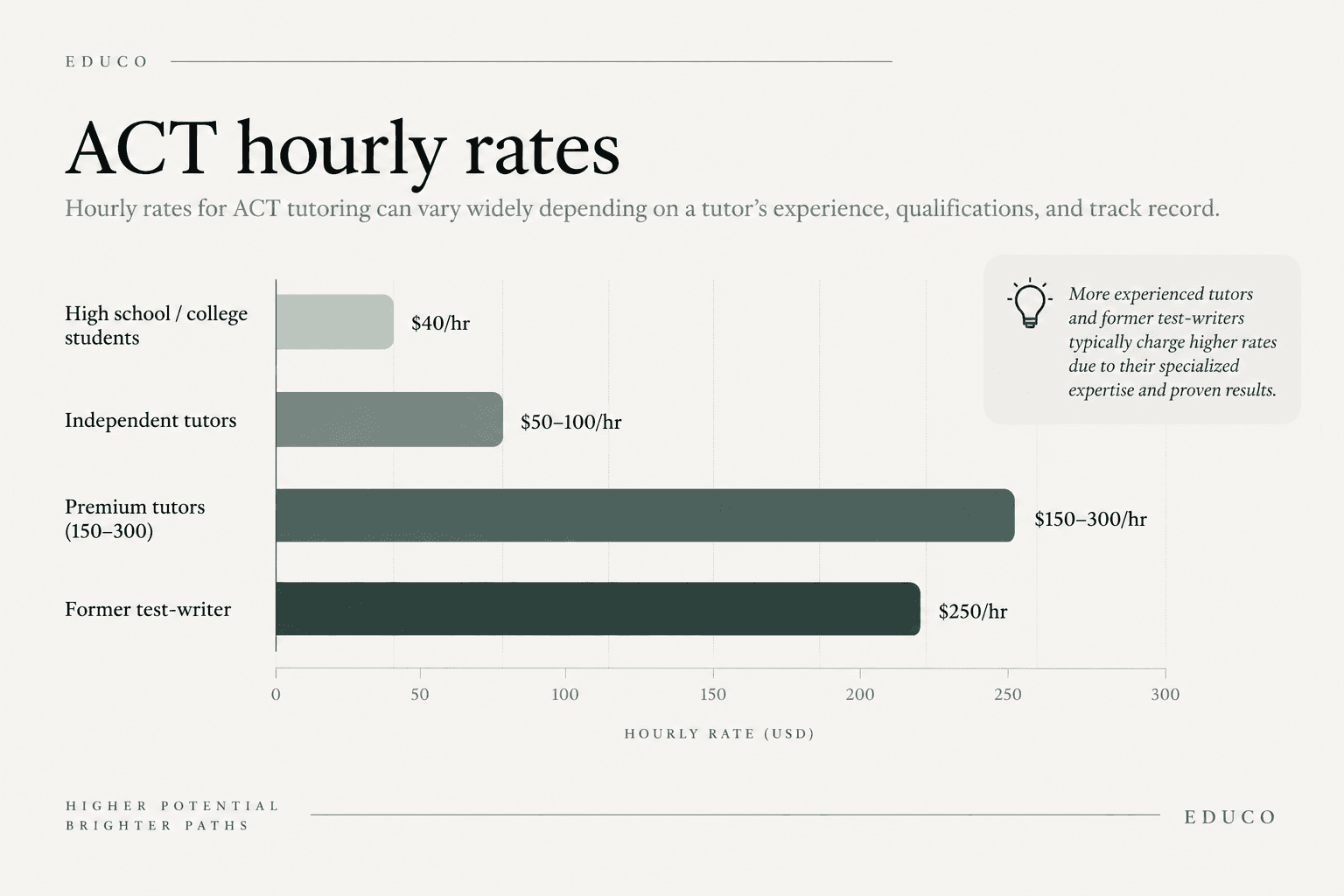
Premium tutors and elite test-prep firms charge $150 to $300 or more per hour. One well-known provider's pricing page lists packages built around $240-per-hour sessions bundled with program directors, full diagnostic batteries, and repeated full-length practice tests scored and reviewed by staff. You're paying for infrastructure at this level, not just a smarter tutor: dedicated curriculum teams, score-tracking systems, and often a guarantee attached to the outcome.
Group courses and online options change the math considerably:
Group classes at test-prep centers can be less costly per student due to shared instruction time.
Online one-on-one tutoring often costs less than comparable in-person sessions due to reduced travel and broader reach.
Subscription-based platforms provide video lessons and practice tests for a flat fee, but lack live interaction and personalization.
Self-paced online courses with some tutor check-ins offer an intermediate option with moderate total costs.
Industry pricing summaries show a tiered cost structure applies broadly across U.S. markets, with urban areas generally charging higher rates than smaller cities.
What Factors Actually Drive ACT Tutoring Prices?
Two tutors can charge wildly different rates for what looks like the same service on paper. The differences usually come down to five factors worth asking about directly before you sign a contract.
Experience and track record. A tutor who has worked with 200 students and can point to specific score patterns commands more than someone tutoring their first few clients, and reasonably so. Ask for a general sense of typical score improvements among past students, not just a single standout result.
Format and session length. One-on-one costs more per hour than group instruction, but a 90-minute session isn't automatically 1.5 times a 60-minute one. Some tutors charge a flat per-session rate regardless of length; others bill strictly by the hour. Confirm which model you're getting before comparing quotes.
What's actually included. Diagnostic testing, official practice-test scoring, written progress reports, and homework review between sessions all add value, but not every quoted rate includes them.
Diagnostics alone can run $50 to $150 as a separate fee at some firms.
Practice-test proctoring and scoring sometimes carries its own charge.
Written progress reports are a premium-tier feature more often than a standard one.
Timing and demand. Rates tend to rise in the weeks before major test dates (September, October, December, February, April, June, and July) simply because demand spikes and tutor calendars fill up. Booking in a slower month can mean more flexible scheduling and occasionally better pricing.
Fine print. Cancellation policies, package expiration dates, and guarantee terms vary enormously between providers and deserve as much scrutiny as the hourly number itself.
Pro Tip: Ask any prospective tutor or firm for a sample progress report or diagnostic breakdown before paying for a package. If they can't show you what "data-driven" actually looks like on paper, the term is probably just marketing language.
How Many Tutoring Hours Does It Take to Improve an ACT Score?
Hour count depends almost entirely on the gap between where a student scores now and where they need to land, and the honest answer is that most families underestimate this.
5 to 10 hours (short prep): works well for a student who's already close to their target and just needs to shore up one weak section, such as math pacing or science data interpretation. This is spot-treatment, not a full rebuild.
15 to 20 hours (medium prep): the most common package size, and industry data suggests this range typically produces modest composite gains, often in the range of 3 to 5 points, though individual results vary based on the starting score and effort outside sessions.
30+ hours (full prep): appropriate for students aiming for a larger jump, often those retaking the test after a disappointing first attempt or targeting a highly competitive score band above 32.
Timing matters as much as hour count, and many students benefit from a milestone-based approach to preparation that aligns with Early Assurance Programs: A Pre-Med's Action Plan on MedSchoolPilot Early Assurance Programs. Test-prep guides consistently recommend starting three to four months before the target test date, which allows steady pacing rather than a last-minute scramble. Starting too close to test day forces cram mode, which limits how much a tutor can actually rebuild weak fundamentals versus just teaching shortcuts.
The dollar math is straightforward once you pick a tier. At $100 per hour, 15 hours costs $1,500 and 30 hours costs $3,000. At $70 per hour, those same packages run $1,050 and $2,100. Many providers offer a modest discount, often 5% to 15%, for buying a larger package upfront rather than paying session by session.
What Does a Realistic ACT Prep Budget Look Like?
Three scenarios cover most families, and none of them require guessing.

Budget-conscious scenario: A group course priced around $400 to $600 combined with five hours of targeted private tutoring at $70 per hour ($350) lands total spend around $750 to $950. This works for a student with decent independent study habits who mainly needs a few sessions on their weakest section.
Mid-range scenario: 15 to 20 hours with a professional tutor at $80 to $120 per hour puts total cost between $1,200 and $2,400, consistent with the $900 to $2,500 range most full preparation packages fall into. This tier typically includes some diagnostic work and regular progress check-ins.
Premium scenario: 30 or more hours with an elite tutor or established firm, often bundled with full diagnostics and repeated official practice tests, can run $4,500 to $9,000 or more depending on hourly rate. This scenario fits students targeting top-tier scores or working with a compressed timeline that requires intensive, structured support.
A few payment realities are worth knowing before you commit:
Most independent tutors and smaller firms offer installment plans rather than requiring full payment upfront.
Package discounts are common but rarely advertised; ask directly.
Some firms offer sibling or referral discounts worth requesting.
Score guarantees, when offered, usually come with specific conditions (attendance minimums, homework completion) worth reading closely before assuming a refund is automatic.
Can You Lower ACT Tutoring Costs Without Losing Results?
Yes, and the hybrid model is the most effective lever most families overlook. Combining a group course with three to five targeted one-on-one sessions on a student's specific weak areas often delivers most of the benefit of full private tutoring at a fraction of the cost.
ACT's own site provides free official practice tests that should be the foundation of any prep plan, tutored or not.
Scheduled self-testing with official materials costs nothing and builds the pacing instincts a tutor can't fully replicate in session time.
A milestone strategy, heavier tutoring investment in the six weeks before a test date and lighter maintenance work otherwise, stretches a fixed budget further than steady weekly sessions spread thin across six months.
Some students, particularly strong independent workers already scoring near their target, don't need a tutor at all and do fine with structured self-study plus one or two diagnostic sessions.
Pro Tip: If budget is tight, spend your tutoring dollars on the diagnostic and the final month before the test. Those two windows deliver the most return per dollar; the middle stretch is where self-study can carry more of the weight.
The Educo Perspective: Pricing Built Around Outcomes, Not Hours
Most of the pricing tiers above sell time. Some providers sell a result, and that distinction shapes how the packages are structured. Every plan starts with performance diagnostics that identify exactly which question types and content areas are costing a student points, rather than a generic curriculum applied the same way to every student. Tutors come from Ivy League backgrounds, and the approach centers on data tracking across every session rather than general test familiarity.
Two things distinguish this from typical mid-range or even premium packages described above: a score-improvement guarantee, rare in an industry where most providers sell hours without accountability for the result, and a 92% family retention rate that suggests the model holds up past a single semester. Case studies documenting specific student outcomes give families something more concrete than a marketing claim to evaluate.
Whatever provider you choose, ask the same three questions: What does the baseline diagnostic actually measure? Can I see anonymized examples of past score trajectories? What happens, contractually, if the target score isn't reached? A provider confident in its methodology answers all three without hedging.
Get Personalized ACT Prep Without the Pricing Guesswork
Educo is the alternative to piecing together hourly tutors, group courses, and free practice materials on your own: one program, one diagnostic-driven plan, and a score guarantee attached to the outcome instead of just the hours billed.
The scenarios above show how quickly costs add up once you factor diagnostics, materials, and enough hours for a real score jump. Educo builds that into the package from day one rather than tacking on fees as you go, with Ivy League tutors and progress tracking baked into every session rather than sold as an upgrade. Families who've gone through multiple other tutoring companies before landing here often say the structured, data-backed approach is what finally moved the score. If you're weighing whether to book a group course, hire an independent tutor, or invest in a full package, start by exploring Educo's ACT and test-prep programs to see how the pricing lines up with a guaranteed outcome.
References & Resources
For official, no-cost material, ACT's free practice test resources remain the most reliable starting point, alongside ACT's own test-preparation product pages. For rate benchmarking, the K12 parent guide on SAT/ACT tutoring rates breaks down pricing by format in plain language worth bookmarking before you start calling tutors.
Frequently Asked Questions
How much does private ACT tutoring typically cost per hour?
Private ACT tutoring typically costs $50 to $200+ per hour, depending on the tutor’s experience, credentials, and level of specialization. College students and newer tutors tend to fall toward the lower end, while experienced private tutors and established test prep firms may charge $150 to $300 or more. When comparing ACT tutoring costs, consider what is included beyond the hourly lesson, such as diagnostic testing, customized study plans, progress tracking, and practice materials.
Is two months enough time to prepare for the ACT?
Two months can be enough time to improve your ACT score, especially if you already have a strong academic foundation and can maintain a consistent study schedule. This timeline works particularly well when preparation focuses on your highest-impact weaknesses rather than reviewing every topic on the exam. For larger score improvements, most students benefit from starting three to four months in advance.
Is $50 an hour too much to pay for ACT tutoring?
No. $50 per hour is toward the lower end of the typical ACT tutoring range and can be reasonable for a college student, recent graduate, or newer tutor with strong subject knowledge. However, price alone does not determine the quality of ACT tutoring. More experienced tutors may charge significantly more while providing personalized diagnostics, strategy development, and ongoing progress tracking.
Do I actually need a tutor for the ACT?
Not necessarily. Students who are already close to their target score and can study independently may be able to prepare effectively using official ACT practice materials. Private ACT tutoring is most valuable for students who need structured accountability, have recurring weaknesses, or are working toward a significant score increase. A good tutor should identify exactly where points are being lost and build a preparation plan around those weaknesses.
How much can ACT tutoring improve my score?
ACT score improvement varies based on a student’s starting score, target score, academic foundation, and consistency. Students with significant content gaps often have more opportunities for improvement, while students already scoring in the 30s may need more targeted work to gain additional points. The best way to estimate potential improvement is through a diagnostic assessment that identifies specific areas for growth.
How many hours of ACT tutoring do I need?
The number of ACT tutoring hours needed depends on your starting score, target score, test date, and amount of independent practice. A student who is already close to their goal may only need a few targeted sessions, while a larger score gap may require a longer preparation program. The most effective approach uses tutoring for targeted instruction while independent practice reinforces the material between sessions.
When should I start ACT prep?
Most students should begin ACT preparation two to four months before their test date. Starting earlier gives you more time to identify weaknesses, build foundational skills, complete practice tests, and adjust your strategy. Students with a significant score gap or ambitious target score may benefit from starting even earlier.
Is ACT tutoring worth the money?
ACT tutoring can be a worthwhile investment when a student needs personalized instruction, accountability, or help identifying why they are losing points. The value comes from making preparation more efficient rather than simply spending more time studying. For students pursuing highly competitive ACT scores, individualized guidance can be particularly valuable.
What should I look for in a private ACT tutor?
Look for a tutor with strong ACT experience, proven academic credentials, and a track record of helping students improve. A strong ACT tutor should provide more than homework help by using diagnostic testing, targeted practice, error analysis, and individualized strategy. Most importantly, they should be able to explain exactly what is holding back your score and how to address it.
Is online ACT tutoring as effective as in-person tutoring?
Yes. Online ACT tutoring can be just as effective as in-person tutoring when sessions are interactive, personalized, and supported by a structured study plan. Online tutoring can also make scheduling easier and allows students and tutors to work directly with digital practice materials and progress data. Ultimately, the quality of the tutor and preparation program matters more than the format.
What is the best way to prepare for the ACT?
The most effective ACT preparation combines diagnostic testing, targeted content review, official practice questions, timed practice, and detailed error analysis. Rather than completing practice tests without reviewing mistakes, students should identify recurring patterns and focus their preparation on the areas most likely to increase their score.
Should I take the ACT or SAT?
Both the ACT and SAT are accepted by colleges, but students may perform better on one based on their strengths, pacing, and testing style. Taking a diagnostic test for each can help determine which exam is the better fit. Once you choose an exam, focused preparation is generally more effective than splitting your time between both.
Relevant Articles